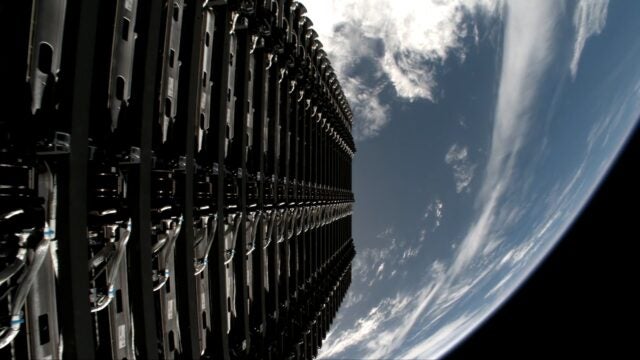
A 100,000-Satellite Constellation Filed on July 7
On July 7, 2026, SpaceX submitted an application to the Federal Communications Commission (FCC) seeking authorization to deploy and operate a third-generation satellite constellation comprising up to 100,000 low-Earth-orbit satellites — roughly 10 times the total number of satellites currently operated by all companies worldwide.
The filing, notably, does not use the "Starlink" brand name, instead referring to the system simply as "Gen3." This is a deliberate distinction: the application positions Gen3 as an entirely new class of orbital infrastructure, not merely an incremental upgrade to the existing Starlink network.
🎯 AI Infrastructure in Space
"AI requires massive uplink capacity to support high-definition spatial and auditory data necessary for real-time decision-making and industrial automation. Without it, the United States cannot compete in the AI revolution." — SpaceX FCC Filing, July 7, 2026
The filing explicitly frames Gen3 not as a consumer broadband product, but as a foundational AI connectivity layer designed to serve billions of AI-powered devices alongside human users.
According to analyst Arun Menon at MTN Consulting, speaking to Fierce Network: "The headline is obviously the 100,000 satellites, but I think the more important story is what SpaceX intends those satellites to support. This filing positions Starlink as AI-connectivity infrastructure rather than simply a satellite broadband network."
Gen3 Satellite Architecture: A Ground-Up Redesign
The third-generation satellites represent a fundamental redesign from the Gen2 platform. Key specifications disclosed in the FCC filing and confirmed by SpaceX include:
🛰️ Satellite Platform
Mass: ~2,000 kg per satellite (Gen2: 575 kg — a 3.5x increase)
Orbit: Very Low Earth Orbit (VLEO), two shells at 323–327.5 km and 473–477.5 km
Inclinations: 26° to 96.9°
Launch vehicle: Starship only (too heavy for Falcon 9)
Propulsion: Argon Hall-effect thrusters for station-keeping
Antenna: Advanced phased array with electronic beam steering
Processing: Next-generation onboard computing and digital beamforming
📊 Capacity Breakdown
Downlink: 1 Tbps per satellite (10x improvement over Gen2)
Uplink: 160–200 Gbps per satellite (22x improvement)
Total RF + Laser backhaul: ~4 Tbps per satellite
Inter-satellite links: Optical ISLs at multi-hundred Gbps to Tbps class
User throughput target: Multi-gigabit symmetrical (1–10 Gbps per terminal)
The VLEO operating altitude of ~350 km is notably lower than current Starlink satellites (~550 km for Gen1, ~340–570 km for Gen2). This reduces signal latency by approximately half, but requires more frequent orbital maintenance due to higher atmospheric drag at these altitudes.
Six Frequency Bands Including Unprecedented W- and D-Band
The most consequential aspect of the Gen3 filing from an RF engineering perspective is the spectrum strategy. SpaceX plans to operate across six distinct frequency bands, including two entirely new bands that have never been used for commercial satellite communications at this scale.
| Band | Frequency Range | Status | Application |
|---|---|---|---|
| Ku-band | 10.7–13.4 GHz | Existing | User downlink (volume capacity) |
| Ka-band | 17.3–21.2 GHz | Existing | User/gateway links |
| V-band | 37.5–42.5 GHz | Existing | High-capacity user + feeder links |
| E-band | 71–86 GHz | Existing | High-capacity feeder links (partially authorized for Gen2) |
| W-band NEW | 75–110 GHz | New Request | Gateway backhaul + high-throughput downlink |
| D-band NEW | 110–170+ GHz (up to 275 GHz) | New Request | Ultra-high-capacity backhaul + AI data uplink |
The W-band and D-band frequencies represent a major leap for satellite RF technology. At these frequencies — particularly in the D-band's 110–275 GHz range — the engineering challenges are substantial:
⚡ W/D-Band Engineering Challenges
Phased array element size: At 100+ GHz, antenna elements become millimeter-scale or smaller, allowing enormous numbers of elements in the same physical aperture. However, manufacturing tolerances become micron-level, and mutual coupling and fabrication defects are far harder to manage.
Active electronics: MMICs and beamformers for W/D-band require advanced semiconductor processes (InP, GaN) with very tight noise and linearity specifications. Current commercial availability is extremely limited.
Atmospheric attenuation: W-band signals face significant rain fade; D-band experiences even higher atmospheric absorption. Adaptive beamforming and advanced modulation (1024-QAM) will be essential.
Spectrum allocation: SpaceX is seeking to "pioneer several new and underused satellite spectrum bands that have not yet received a formal satellite frequency allocation" — a bold regulatory play.
Next-Generation Phased Arrays: From Space to Ground
The Gen3 filing reveals a comprehensive phased array strategy spanning both the space segment and ground terminals. This is where the RF engineering community will see the most immediate impact.
Space-Segment Phased Arrays
Each Gen3 satellite will be equipped with advanced phased array beamforming and digital processing technologies, featuring electronic beam steering capabilities. The filing describes a system that uses:
- Multi-band shared-aperture or stacked phased array designs
- Hybrid digital/analog beamforming with on-board AI for dynamic spectrum management
- Advanced power amplifiers with dynamic power control
- Higher-order modulation schemes for spectral efficiency
- Denser frequency reuse enabled by narrower beams at higher frequencies
Ground Terminal Revolution
Perhaps the most significant implication for the RF industry is the ground terminal impact. The filing acknowledges that existing Starlink user terminals and antenna hardware will need upgrades to leverage the Gen3 constellation's capabilities.
📡 Next-Gen Terminal Requirements
Multi-band phased arrays: Supporting Ku/Ka/V/E and potentially W-band in a single terminal aperture
Larger array apertures: Current flat-panel designs need expansion for higher-frequency operation
Higher EIRP/G/T: To exploit multi-gigabit symmetrical throughput, especially uplink
Advanced beam tracking: VLEO satellites at 350 km move faster across the sky, requiring faster beam steering
W/D-band RF front-ends: New MMICs, LNAs, and power amplifiers operating at 75–275 GHz
AI-assisted spectrum management: Dynamic beam and power control with real-time interference avoidance
The industry trend toward lower-cost phased array terminals is accelerating. Industry estimates suggest Gen3-compatible terminals will initially be larger and more expensive, but economies of scale — driven by 100,000 satellites requiring corresponding ground infrastructure — should eventually drive costs down. Current Gen2 terminals retail at approximately $599; the Gen3 terminal ecosystem will need to balance performance with affordability.
A Wave of New Constellation Filings
SpaceX's Gen3 application is part of a broader FCC processing round for Non-Geostationary Orbit (NGSO) fixed-satellite service (FSS) operations. Multiple companies submitted filings in the same Ka, Ku, and V bands during the same week:
The density of filings in a single processing round underscores the accelerating pace of LEO constellation development and the intense competition for spectrum and orbital resources.
What This Means for the RF & Satellite Ground Equipment Industry
The scale and technical ambition of the Gen3 filing — combined with the broader constellation wave — has profound implications for RF component manufacturers, terminal designers, and ground system integrators.
🔧 W/D-Band Component Demand
New MMICs, LNAs, PAs, and beamformers operating at 75–275 GHz will be needed at scale. This opens a major market for GaN and InP semiconductor manufacturers.
📡 Multi-Band Terminal Design
Terminals supporting 4–6 frequency bands simultaneously will require advanced shared-aperture antenna designs and wideband RF front-ends — a significant engineering challenge.
🏭 Manufacturing at Scale
100,000 satellites × corresponding ground terminals = hundreds of thousands of phased array systems. This demands industrial-scale RF manufacturing capabilities.
🌐 Spectrum Sharing Tech
Denser constellations mean more complex spectrum sharing. Advanced interference management, cognitive radio, and AI-driven frequency allocation will become critical.
⚡ Power & Thermal Design
W/D-band operation at scale requires breakthrough power efficiency and thermal management solutions for both satellite payloads and ground terminals.
🔗 Optical-ISL Integration
With optical inter-satellite links handling most inter-satellite traffic, RF spectrum pressure is reduced, but hybrid RF/optical terminal designs add complexity.
💡 Key Takeaway for Ground Equipment Providers
The Gen3 filing signals that the satellite terminal market is about to undergo a fundamental technology shift. Multi-band phased arrays with W/D-band capability, AI-assisted spectrum management, and industrial-scale manufacturing will define the next generation of satellite ground equipment. Companies that can deliver cost-effective, multi-band RF solutions at scale will be well-positioned in this emerging market.
Deployment Timeline & Regulatory Outlook
BNP Paribas estimates that a fully scaled Gen3 constellation could support 200 million subscribers globally, with 15–20 million in the U.S. alone. The bank identifies cable broadband operators as "the most vulnerable business" given Gen3's potential penetration in rural and underserved markets.
The FCC's new Space Modernization Order, expected to be voted on July 22, 2026, could accelerate licensing by creating a faster processing framework and extending station licenses to 20 years — a critical enabler for the economics of mega-constellations.
Sources
- SpaceX Files for 100,000-Satellite Gen-3 Constellation — Satellite Today, Jul 9, 2026
- SpaceX files FCC request for 100,000 Starlink satellites — Fierce Network, Jul 8, 2026
- Elon Musk Says 'We're Gonna Need A Bigger Rocket' — Benzinga, Jul 8, 2026
- CesiumAstro Files for 737-Satellite Synchronicity Constellation — Satellite Today, Jul 7, 2026
- Satellite Processing Round Sees Plans for Multiple Constellations — Communications Daily, Jul 8, 2026
- SpaceX 10万颗第三代星链卫星 — 36Kr, Jul 10, 2026