Why GPS Resilience Has Become a National Security Imperative
Modern civilization runs on satellite timing. From mobile networks and banking systems to power grids and autonomous vehicles, the Global Navigation Satellite System (GNSS) provides the precise time signals that keep critical infrastructure synchronized. But this dependency has become a vulnerability.
GNSS signals traveling from orbit 20,200 km above Earth arrive at receiver level weaker than a candle flame seen from 10 kilometers away. This makes them susceptible to both jamming (blocking signals with brute-force RF noise) and spoofing (sending convincing counterfeit signals that trick receivers into accepting wrong positions or time).
The threat is no longer theoretical. In contested environments worldwide, GNSS signals are being disrupted as an act of war. The U.S. Government Accountability Office has formally noted that GPS and PNT services face escalating threats from jamming, spoofing, cyber risks, and anti-satellite weapons. In response, military services across multiple nations are developing alternative PNT capabilities to complement — and eventually supplement — GPS.
Two Quantum Timing Milestones, Announced Within Hours
On July 7, 2026, two organizations on opposite sides of the globe independently announced breakthroughs in quantum-enabled timing technology — both aimed at the same fundamental problem: how to maintain precision timekeeping when GPS signals are unavailable, disrupted, or unreliable.
Ramsey-CPT Quantum Atomic Clock
- Successfully demonstrated high-sensitivity atomic clock based on Ramsey Coherent Population Trapping (Ramsey-CPT) platform
- Achieved short-term fractional frequency stability of 1 × 10⁻¹³ at 1 second
- Targets chip-scale atomic clock miniaturization
- Applications: military platforms, UAVs, communications networks, data centers, financial infrastructure
- Leverages core competencies in atomic physics, photonics, precision lasers, and quantum control
Quantum Entanglement Light Source
- Designed, built, and delivered two high-flux entangled photon sources to Defence Science and Technology Group (DSTG)
- Enables secure ground-to-satellite time transfer using quantum entanglement
- Inherently spoof-proof — any interception attempt changes the quantum state and is instantly detectable
- Portable and field-deployable to optical ground stations
- Developed with Heriot-Watt University (UK), built in Australia for sovereign capability
While these approaches differ fundamentally — Quantum X Labs focuses on self-contained atomic timing that doesn't need external signals, while CSIRO builds quantum-secured links to satellites — both represent the same strategic shift: moving from trust-the-signal to trust-the-physics for critical timing infrastructure.
Quantum X Labs: From Lab Demonstration to Chip-Scale Clocks
Quantum X Labs Inc. (Nasdaq: QXL), operating through its wholly-owned Israeli subsidiary, demonstrated what it calls a "foundational component" of its broader quantum sensing strategy. The Ramsey-CPT technique uses lasers to trap atoms in specific quantum states, creating a frequency reference that can be made compact enough for field deployment.
🔬 Key Technical Achievement
The demonstrated system achieved a short-term fractional frequency stability of 1 × 10⁻¹³ at 1 second. While this performance level is typical for laboratory demonstrations of the technique, the significance lies in the platform's potential trajectory: Ramsey-CPT is one of the leading candidates for chip-scale atomic clocks (CSACs), which pack atomic-clock-level precision into packages smaller than a matchbox.
🎯 Why It Matters for GNSS Users
The current chip-scale atomic clock market was estimated at $47 million in 2023 and is projected to reach $86 million by 2030 (QYResearch). These tiny clocks serve as holdover oscillators in GNSS receivers — when satellite signals are temporarily lost (due to jamming, urban canyon effects, or tunnel passage), the CSAC maintains timing accuracy until signals are reacquired. The better the holdover performance, the longer a system can operate independently of GPS.
Prof. Nir Sharon, Chief Scientist of Quantum X Labs, stated: "Our quantum atomic clock represents a foundational component of Quantum X Labs' broader quantum sensing strategy. Together with our optical gyroscopes, inertial sensing technologies and other quantum sensing platforms under development, the Ramsey-CPT atomic clock leverages the same core competencies in atomic physics, photonics, precision lasers and quantum control."
CSIRO: Quantum Entanglement as the Ultimate Anti-Spoof Shield
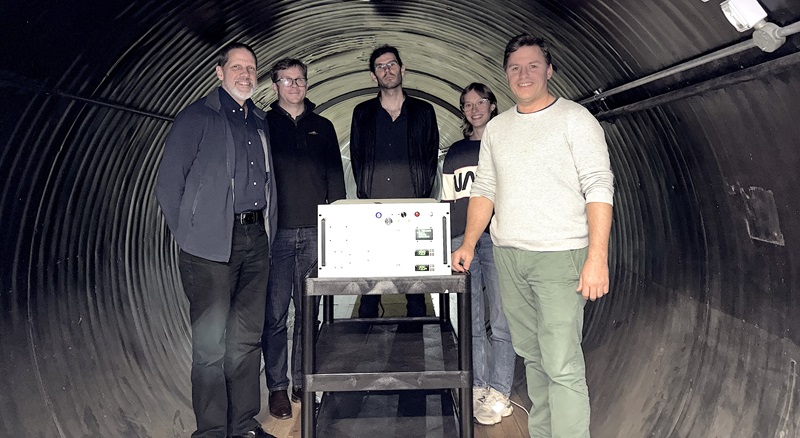
Australia's national science agency CSIRO took a fundamentally different approach — rather than building a self-contained clock, they built a quantum-secured link between ground and satellite using entangled photons.
🔬 How It Works
The CSIRO Quantum Light Source generates pairs of entangled photons. One photon remains at a ground station while its entangled partner is beamed to an orbiting satellite hundreds of kilometers away. Because quantum entanglement means any measurement of one photon instantly affects its partner — and any interception attempt irrevocably changes the quantum state — the link is physically impossible to spoof without detection.
As Dr. Matt Broome, CSIRO Technical Lead, explained: "This work is a significant milestone in the development of quantum-secure time transfer in Australia. With this work, CSIRO has developed specialised capability, which puts Australia on the path to a more resilient future in global positioning technology."
🛡️ Civilian Applications Beyond Defence
While developed under a DSTG-led defence project, CSIRO emphasizes the dual-use nature of the technology. The same secure timing that protects military systems from GNSS disruption also shields civilian infrastructure — telecommunications networks, power grids, financial trading systems, and autonomous transport — all of which rely on nanosecond-level timing accuracy that GPS currently provides.
The Accelerating Push for Resilient PNT
These two breakthroughs arrive amid a broader acceleration in resilient positioning, navigation, and timing (PNT) programs worldwide. Several concurrent developments paint the full picture:
| Initiative / Event | Organization | Relevance |
|---|---|---|
| DARPA ROCkN Program | U.S. Defense Dept. | Robust Optical Clock Network — precision timekeeping in GPS-denied environments; requires billionths-of-a-second synchronization for missiles, sensors, aircraft, ships |
| EU CE-RED 6G RF Testing Mandate | European Commission | Effective Nov 2026: AI smartphones must pass 6G pre-sweep testing across Sub-6 GHz and sub-THz bands — driving demand for precision timing at the chip level |
| China Distributed Timing Breakthrough | China National Institute of Metrology (NIM) | UTC(NIM) deviation reduced to below 1ns from UTC; BeiDou-based time-frequency calibration passed international accreditation — 1.8ns uncertainty |
| Furuno GF-100 GNSS disciplined oscillator | Furuno (Japan) | New anti-jamming, anti-spoofing GNSS-DO series announced — addressing the exact threat landscape Quantum X Labs and CSIRO are targeting |
| GlobalFoundries + Qualinx European GNSS chip | GF / Qualinx | First fully European end-to-end GNSS SoC manufacturing flow — supply chain sovereignty for PNT-dependent applications |
📊 The Market Signal
The global atomic clock market was valued at $512.7 million in 2024 and is projected to exceed $965 million by 2030 at an 11.1% CAGR (Intent Market Research). The chip-scale segment alone is expected to nearly double from $47M to $86M in the same period.
This growth isn't driven by incremental improvement in existing products — it's driven by a structural shift in how critical infrastructure approaches timing resilience: from "trust GPS forever" to "maintain accuracy even when GPS fails."
What This Means for RF, Satellite & Timing Professionals
1. GNSS Receiver Design Evolution
As chip-scale atomic clocks improve in performance and decrease in cost, they will transition from niche military components to standard elements in commercial GNSS receivers. RF front-end designers will need to account for tighter integration between the timing reference and the signal processing chain, particularly for multi-constellation, multi-frequency architectures.
2. Ground Terminal Timing Architecture
Satellite ground stations — particularly those supporting LEO constellations that require precise TT&C timing — face a dual opportunity: integrate quantum-secured timing links (CSIRO approach) and/or upgrade holdover oscillators to next-generation CSACs (Quantum X Labs approach). Both paths demand new RF component specifications.
3. Anti-Jamming / Anti-Spoofing as a Product Feature
The Furuno GF-100 announcement and the broader market trend signal that GNSS-disciplined oscillators with AJA/S capabilities are becoming a product category. Manufacturers of timing modules, oscillators, and frequency references should expect AJA/S features to move from "differentiator" to "table stakes" over the next 2-3 years.
4. Supply Chain Sovereignty
China's BeiDou calibration achieving international accreditation, the EU's first all-European GNSS chip flow, and Australia's sovereign quantum timing capability all point to the same trend: timing infrastructure is becoming a matter of national technology sovereignty, not just a technical procurement decision. This creates opportunities for suppliers who can serve multiple sovereign PNT programs simultaneously.
📚 Sources & References
- Quantum X Labs Inc. (Jul 7, 2026). "Quantum X Labs Achieves Key Technological Milestone in Its Quantum Atomic Clock Development." GlobeNewswire via TMCnet
- CSIRO (Jul 7, 2026). "Using quantum entanglement to secure ground-to-satellite timing." CSIRO News
- Intent Market Research. Global Atomic Clock Market Report (2024–2030).
- QYResearch. Chip-Scale Atomic Clock Market Report (2023–2030).
- GPS World (Jul 6, 2026). "SparkFun unveils SparkPNT, its open-source GNSS receiver subsidiary." gpsworld.com
- Inside GNSS (Jul 7, 2026). "Calian for Resilient GNSS, From Water to Space." insidegnss.com
- European Commission (May 6, 2026). Revised Annex III to Radio Equipment Directive (2014/53/EU), OJEU.
- DARPA. "Robust Optical Clock Network (ROCkN)." darpa.mil